






What Happened
On the evening of December 28th, a vehicle attempted unauthorized entry into the Eastridge Hills community.
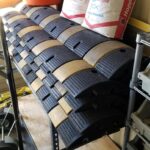
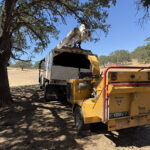
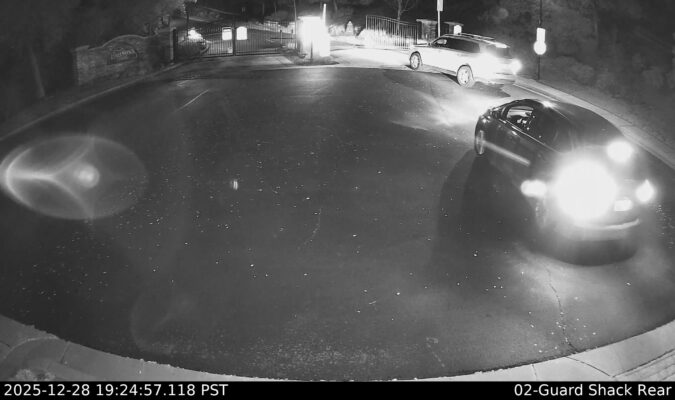
The sequence of events is documented by both still photography and security camera video:
- Initial Tailgating Attempt (Through the Entrance Gate)
A vehicle attempted to enter the community by closely following an authorized vehicle through the entrance gate—commonly known as tailgating.
• Entry was successfully denied
• The driver reversed and left the entrance lane
- Secondary Attempt via Exit Gate
Security camera footage later shows the same vehicle repositioning and attempting to enter the community through the exit gate, a maneuver explicitly prohibited and engineered against.
- Outcome
As designed, the exit gate’s physical deterrent system engaged, resulting in tire damage to the unauthorized vehicle and preventing entry.
No residents were harmed. No property inside the community was accessed.
Why This Matters
This incident highlights several important facts that are often overlooked when discussions focus narrowly on cost reduction or technology-only access systems.
Tailgating is the primary failure point of unmanned gates.
Unauthorized access almost never occurs through forced entry . . . it occurs when someone attempts to exploit legitimate openings.
Technology worked . . . but only because human judgment already set the rules.
The gate hardware functioned exactly as intended. However:
- The decision-making framework that defines authorized vs. unauthorized access
- The rules that prohibit exit-gate entry
- The response protocols following the incident
- These all exist because people designed, enforced, and monitored them.
The Role of a Live Guard
A trained, on-site security guard adds layers of protection that no keypad, QR code, or remote system can replace:
• Immediate visual deterrence to tailgaters
• Active judgment when behavior appears suspicious
• Prevention, rather than after-the-fact enforcement
• Controlled contractor and vendor access
• Faster incident recognition and response
• Reduced likelihood of escalation or damage
In this incident, the outcome could have been very different had the exit gate not been properly engineered—or had multiple access points remained unmonitored.
Why the Back Gate Deserves Equal Attention
This event underscores why secondary access points . . . including our HOA-controlled back gate—require thoughtful security coverage.
Unmonitored or lightly monitored gates:
- Attract repeat attempts after a failed entry elsewhere
- Become predictable vulnerabilities
- Shift risk rather than reduce it
A part-time, live guard presence at the back gate strengthens the entire perimeter and reduces the likelihood that incidents escalate to physical damage, resident risk, or liability exposure.
The Cost Conversation—In Context
Security decisions should not be evaluated solely on short-term operating costs.
The real question is:
What is the cost of one successful unauthorized entry?
Potential consequences include:
- Property damage
- Personal safety risks
- Legal exposure
- Insurance claims
- Reputational harm
- Diminished buyer confidence in a “gated” community
Prevention costs less than explanation—every time.
Our Responsibility
Eastridge Hills HOA exists to provide a safe, well-managed, and well-protected residential environment.
That responsibility includes:
- Learning from real incidents
- Using evidence, not speculation
- Investing where risk is demonstrably present
This documented event reinforces the Board’s ongoing evaluation of robust, human-centered security, including enhanced coverage at all access points.
Security is not just a gate.
It is a system designed, enforced, and supervised by people.
Community Information Website Disclaimer
EastridgeHills.com is an independent community website created by residents of Eastridge Hills. This website is not owned, operated, sponsored, endorsed, or authorized by the Eastridge Hills Homeowners Association, its Board of Directors, management company, or legal counsel.
Information presented on this website reflects the opinions, observations, and interpretations of its contributors. Official Association notices, governing documents, meeting agendas, election materials, financial disclosures, and legal communications should be obtained through the Association’s official communication channels.


I don’t recall ever getting a notice of increase for HOA dues from $205 to $216.69. Did I miss this notice? I received a payment coupon book that says $216.69 is due each month. Then I received a statement for February that says $205. is due. Please clarify. Tks.
Yes . . . sometimes things get lost in the large volume of emails and text messages we get each day. If you can look back to around November 3rd, 2025, our management company sent out the Official Annual Disclosure Statements for Fiscal Year 2026 where HOA dues were raised to $216.69. I didn’t get my invoice for February yet, and Silvercreek always posts the “assessment” on the first day of the month…so I can’t figure out where you got an invoice for $205.00? Switching to a new management company has been challenging specially for something as important as monthly dues invoicing. The HOA Board is trying hard to correct some of the misappropriated finances from the Kelly Company and their relationship with the Eastridge Property Owners Association but it is like trying to swim through Jello. I trust Silvercreek will resolve this and other issues as we peel the onion. At your suggestion, I will try to post the entire 71 page Disclosure document to this web site but it should also be on the Silvercreek portal (http://portal.silvercreekam.com)
Thanks for your reply. One more thing on the back gate issue. While entering the back gate someone was trying to piggy back me. I stopped my car and got out to direct them to the front gate. They refused to leave so upon trying to back up to go down the hill to the front, I backed into one of those poles by accident. Priscilla charged me $700. 😳 For the repair. I thought rather excessive. Just so you know, I own that pole. Lol
I’m sorry that your good deed did not get rewarded. The Kelly Company took the $700 and bought a $50 post and screwed it to the ground. The remainder went to The TK Company, a construction company owned by The Kelly Company. But as you know, The Kelly Company doesn’t work for us anymore.