





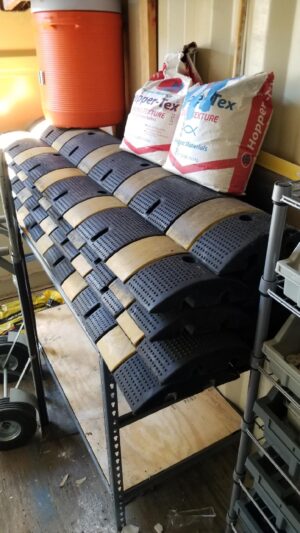
Seven Speed Bumps . . .
One Lesson: Finding the Right Balance
One of the most visible improvements completed by the HOA this year was the reconstruction of our neighborhood speed bumps. All seven were rebuilt to provide a more uniform height and profile appropriate for our 25 mph community speed limit. The result is a smoother, more consistent experience for drivers and a more professional appearance throughout Eastridge Hills.
The project also gave the Board an opportunity to reconsider whether every speed bump was still serving its original purpose.
The Exit Gate Speed Bump
Longtime residents may remember the speed bump located just before the exit gate. Unlike the others, it covered only about half the roadway. Not surprisingly, many drivers simply steered into the opposite lane to avoid it altogether. While our Rules & Regulations technically discouraged avoiding a speed bump, many residents understandably questioned the practicality of a rule that effectively asked drivers to hit a bump they could safely steer around.
In the end, the HOA chose to remove that particular speed bump rather than replace it.
That decision raises an interesting question:
How much protection is enough?
Managing Risk—Not Eliminating It
The exit speed bump was originally installed after a young driver lost control of a vehicle many years ago. Fortunately, that type of accident has never become a pattern. Despite thousands upon thousands of vehicles exiting our community over the past two decades, no similar incident has occurred.
Every accident deserves to be taken seriously. Even one preventable injury matters.
But good governance also requires asking another question:
Should a single isolated event automatically justify permanent infrastructure and ongoing maintenance costs forever?
Risk can rarely be reduced to zero. If our goal were to eliminate every conceivable risk, we’d soon discover that there is no logical stopping point . . . and no practical budget to support it.
Every Safety Improvement Has Trade-Offs
Speed bumps are effective at one thing: encouraging drivers to slow down.
That benefit is real.
They also come with trade-offs that are easy to overlook.
Every vehicle crossing a speed bump transfers weight as it brakes, climbs, and descends the hump. Engineers have long recognized that these repeated dynamic forces concentrate stress near the speed bump itself. Over time, those areas can experience greater wear than a smooth roadway, especially where heavier vehicles such as garbage trucks, moving vans, delivery vehicles, and emergency equipment regularly travel.
That doesn’t mean speed bumps are a mistake.
It simply reminds us that every safety improvement has both benefits and costs.
Spending Members’ Money Wisely
One of the Board’s most important responsibilities is its fiduciary duty to manage Association funds carefully.
Sometimes that means investing in projects that clearly improve safety.
Sometimes it also means asking whether an existing feature still provides enough benefit to justify its continued maintenance.
Removing one ineffective speed bump while rebuilding the remaining seven demonstrates that the Board was willing to evaluate each installation on its own merits instead of simply replacing everything because “that’s the way it’s always been.”
That is the kind of thoughtful stewardship homeowners should expect.
Safety Begins With Us
No collection of speed bumps can replace good judgment.
The safest neighborhood is created by residents who drive attentively, obey the 25 mph speed limit, watch for children, pedestrians, pets, bicyclists, and neighbors enjoying our streets.
In the end, the best traffic-calming device isn’t made of asphalt.
It’s the person behind the steering wheel.
As our community continues to invest in maintaining our streets, we should continue asking thoughtful questions about where our maintenance dollars provide the greatest benefit. Protecting both our neighbors and our financial resources isn’t an either-or decision. With careful planning, we can and should do both.